
READ 2017:
Do Not Say We Have Nothing…Madeline Thien
The Sympathizer…..Nguyen
Commonwealth…Anne Patchett
The Break….Vermette
A Darker Shade of Magic…V.E. Schwa
The Gene….Sidhartha Muckerjee
The Secret Life of Trees
To Read:
The Sellout….Beatty
I’m Your Man: The Life of Leonard Cohen…..Simmons
Nostalgia….Vassanji
I Am Woman…..Maracle
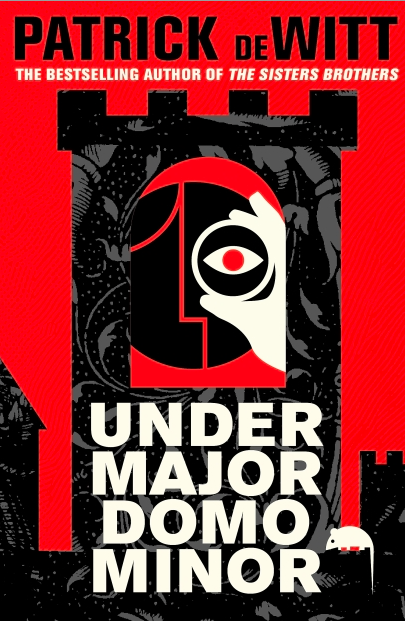
Undermajorodomo Minor by Patrick DeWitt
1/29/2016 Book Circle Book
Under majordomo Minor, just like DeWitt’s first book, The Sisters Brothers, is quirky, dark and comedic in equal parts. Set in an indeterminate time and place, the book is a curious hybrid of gothic horror and love story.
Lucien Minor, the 17-year-old protagonist, is an unlikely hero by all accounts. An inveterate liar, Lucy has lived a largely unhappy and uneventful life when circumstances force him to relocate from Bury to the Castle Aux as an underpaid amanuensis to Mr. Olderglough, the majordomo to the mad Baron of Aux.
Laughed out of town by Marina — his former lover — and her new brutish paramour, Tor, Lucy travels third class by train to his new station. En route he encounters the thieves Memel and Mewe, who catch him out in another self-aggrandizing lie and rob him of his pipe.
He is accosted by his soon-to-be rival, Adolphus, while waiting to be let into the castle. Adolphus is everything Lucy is not — physically imposing, charismatic and fearless. Stripped of his cash and his pride by Adolphus and his troupe of soldiers, Lucy learns that the area surrounding Aux is a battlefield. Not of a war proper, but of some undefined and regional skirmish about which no one will enlighten him.
Throughout the book Lucy’s lack of understanding about what is actually transpiring — about his employer the Baron, his love life with Memel’s daughter Klara, the depravity of the returning Baroness and her guests and the fate of his predecessor, Mr. Broom — creates an engaging mixture of suspense and and dark comedy.
Like DeWitt’s first novel, almost random acts of extreme violence are sprinkled throughout the book, greatly heightening the tension of the otherwise spare and often almost allegorical story lines laying out Lucy and Klara’s relationship and the counterpoint plot of the Baron and Baroness’s corrupted and corrupting tale.
After falling into The Great Hole and miraculously surviving , Lucy discovers Tomas and Mr. Broom - two other love-lorn characters — languishing in the bottom regions of the giant cave, existing on raw fish and hope. He eventually makes his way out of the cave, only to find that Adolphus has been killed and Klara has left town as servant to the dissolute Baroness.
He leaves to pursue Klara, a somewhat wiser, active and more forceful man than when he first came to Aux. Just like Memel, who penned his own epitaph …
He wandered here and there over rolling hills.
He never saw the ocean
But dreamed of it often enough,
Lucy pens his own more hopeful ending…
His hear was church of his own choosing,
And the lights came through
The colourful windows.
Enjoyed the book, though I think The Sisters Brothers was a more polished and funnier read. Undermajordomo Minor was a good read …I ripped through it in two sittings, but I wasn’t quite sure how “weighty” it was trying to be ultimately. At times the book’s mood and atmosphere reminded me of The Gormenghast Triology, another quirky take on love and things gothic. Thought that the style and structure of the book was perhaps trying to be allegorically more profound than the simple dialogue and storylines suggest at first reading. I found the mixture of comedy, dark humor and a gothic world in disrepair engaging for the most part.
Do Not Say We Have Nothing…Madeline Thien
The Sympathizer…..Nguyen
Commonwealth…Anne Patchett
The Break….Vermette
A Darker Shade of Magic…V.E. Schwa
The Gene….Sidhartha Muckerjee
The Secret Life of Trees
To Read:
The Sellout….Beatty
I’m Your Man: The Life of Leonard Cohen…..Simmons
Nostalgia….Vassanji
I Am Woman…..Maracle
Undermajorodomo Minor by Patrick DeWitt
1/29/2016 Book Circle Book
Under majordomo Minor, just like DeWitt’s first book, The Sisters Brothers, is quirky, dark and comedic in equal parts. Set in an indeterminate time and place, the book is a curious hybrid of gothic horror and love story.
Lucien Minor, the 17-year-old protagonist, is an unlikely hero by all accounts. An inveterate liar, Lucy has lived a largely unhappy and uneventful life when circumstances force him to relocate from Bury to the Castle Aux as an underpaid amanuensis to Mr. Olderglough, the majordomo to the mad Baron of Aux.
Laughed out of town by Marina — his former lover — and her new brutish paramour, Tor, Lucy travels third class by train to his new station. En route he encounters the thieves Memel and Mewe, who catch him out in another self-aggrandizing lie and rob him of his pipe.
He is accosted by his soon-to-be rival, Adolphus, while waiting to be let into the castle. Adolphus is everything Lucy is not — physically imposing, charismatic and fearless. Stripped of his cash and his pride by Adolphus and his troupe of soldiers, Lucy learns that the area surrounding Aux is a battlefield. Not of a war proper, but of some undefined and regional skirmish about which no one will enlighten him.
Throughout the book Lucy’s lack of understanding about what is actually transpiring — about his employer the Baron, his love life with Memel’s daughter Klara, the depravity of the returning Baroness and her guests and the fate of his predecessor, Mr. Broom — creates an engaging mixture of suspense and and dark comedy.
Like DeWitt’s first novel, almost random acts of extreme violence are sprinkled throughout the book, greatly heightening the tension of the otherwise spare and often almost allegorical story lines laying out Lucy and Klara’s relationship and the counterpoint plot of the Baron and Baroness’s corrupted and corrupting tale.
After falling into The Great Hole and miraculously surviving , Lucy discovers Tomas and Mr. Broom - two other love-lorn characters — languishing in the bottom regions of the giant cave, existing on raw fish and hope. He eventually makes his way out of the cave, only to find that Adolphus has been killed and Klara has left town as servant to the dissolute Baroness.
He leaves to pursue Klara, a somewhat wiser, active and more forceful man than when he first came to Aux. Just like Memel, who penned his own epitaph …
He wandered here and there over rolling hills.
He never saw the ocean
But dreamed of it often enough,
Lucy pens his own more hopeful ending…
His hear was church of his own choosing,
And the lights came through
The colourful windows.
Enjoyed the book, though I think The Sisters Brothers was a more polished and funnier read. Undermajordomo Minor was a good read …I ripped through it in two sittings, but I wasn’t quite sure how “weighty” it was trying to be ultimately. At times the book’s mood and atmosphere reminded me of The Gormenghast Triology, another quirky take on love and things gothic. Thought that the style and structure of the book was perhaps trying to be allegorically more profound than the simple dialogue and storylines suggest at first reading. I found the mixture of comedy, dark humor and a gothic world in disrepair engaging for the most part.
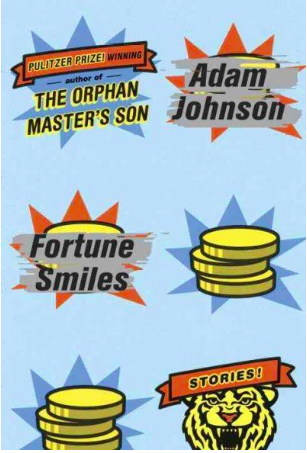
Fortune Smiles by Adam Johnson
1/15/2016
This collection of stories is worthy of the Pulitzer it won. Though all of the stories are at heart dark — the world is consistently a grim and anxious place in this book —Johnson’s weird, absurdist take on matters perfectly counterbalances the downward trajectory of his characters’ lives.
Beautifully written, always atmospheric, Johnson’s stories all contain protagonists who are deeply flawed and troubled people. Amazingly we come to care for and even empathize with these damaged men and women… each poised on the brink of a moral cliff. In Dark Meadows, we follow the struggles of a man with pedophilic tendencies, who was himself abused as a young boy. We are invited to see Mr. Roses as something other than disgusting and repulsive — in a story that suggests there will be a less than happy conclusion. In Hurricanes Anonymous, we are taken along the same unlikely path to empathy for the hapless Nunc, who desperately wants to do the right thing with his life, but almost certainly will not.
In Nirvana, a tech-savy husband whose wife is paralyzed by Guillame-Barre and suicidal, creates a hologram of the recently-assassinated president of the USA to comfort himself. The hologram goes viral, and millions of people download and engage the program — a collective response to grief mirroring his own private battle. Eventually he creates a Kurt Cobain hologram to sustain his traumatized wife after an epiphany about the individual nature of suffering and grief.
Thoroughly enjoyed Johnson’s skill and his wonderfully quirky and mercurial wit.
1/15/2016
This collection of stories is worthy of the Pulitzer it won. Though all of the stories are at heart dark — the world is consistently a grim and anxious place in this book —Johnson’s weird, absurdist take on matters perfectly counterbalances the downward trajectory of his characters’ lives.
Beautifully written, always atmospheric, Johnson’s stories all contain protagonists who are deeply flawed and troubled people. Amazingly we come to care for and even empathize with these damaged men and women… each poised on the brink of a moral cliff. In Dark Meadows, we follow the struggles of a man with pedophilic tendencies, who was himself abused as a young boy. We are invited to see Mr. Roses as something other than disgusting and repulsive — in a story that suggests there will be a less than happy conclusion. In Hurricanes Anonymous, we are taken along the same unlikely path to empathy for the hapless Nunc, who desperately wants to do the right thing with his life, but almost certainly will not.
In Nirvana, a tech-savy husband whose wife is paralyzed by Guillame-Barre and suicidal, creates a hologram of the recently-assassinated president of the USA to comfort himself. The hologram goes viral, and millions of people download and engage the program — a collective response to grief mirroring his own private battle. Eventually he creates a Kurt Cobain hologram to sustain his traumatized wife after an epiphany about the individual nature of suffering and grief.
Thoroughly enjoyed Johnson’s skill and his wonderfully quirky and mercurial wit.
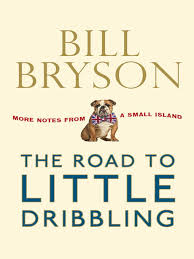
The Road To Little Dribbling by Bill Bryson
1/12/2016
Not Bryson’s best effort…but still mildly entertaining. I enjoyed Notes From A Small Island and A Walk In The Woods much more. There were a few times I laughed out loud, but after the third or fourth tirade against bad manners or people’s stupidity, it felt like he needed to find some other things to take to task. Liked some of Bryson’s descriptions of the towns and landscapes and some of the quirky historical matters he explores and his enthusiasm for walking and exploring does come through at times.
1/12/2016
Not Bryson’s best effort…but still mildly entertaining. I enjoyed Notes From A Small Island and A Walk In The Woods much more. There were a few times I laughed out loud, but after the third or fourth tirade against bad manners or people’s stupidity, it felt like he needed to find some other things to take to task. Liked some of Bryson’s descriptions of the towns and landscapes and some of the quirky historical matters he explores and his enthusiasm for walking and exploring does come through at times.
All the Light We Cannot See by Anthony Doerr
1/8/2016 Book Circle
This book was a pleasure to read, even though some of the subject matter is harrowing. It follows the trajectories of Marie-Laure LeBlanc — a blind French girl — and Werner Pfennig — a gifted German orphan — through events leading up the Second World War and all through it. Werner is preternaturally inquisitive and eventually finds and restores a broken crystal radio set. Marie-Laure is also curious about the world, which is an enormous mystery to her because of her blindness.
Both are driven to acquire knowledge and to engage the world. But possession in the book — of knowledge, or family or even the Sea of Flames diamond — is a dangerous thing. Dangerous because you may lose what you have almost at random. Dispossession and loneliness lurk everywhere for the two main characters.
The writing was masterful. Doerr uses dozens of very short vignettes not in chronological order to create a beautiful, lyrical pastiche of the two major characters’ lives. The book has many metaphors and themes that run through it and Doerr uses the short chapters to good effect in developing them. The non-linear, layered style of the book mirrors the world he creates. A world where where beauty and brutality exist in equal and random measure among moments of insignificance and the miraculous. Doerr has a wonderful eye for detail, especially imagery relating to the five senses.
The book presents the world as a series of overlapping and interlocking mazes that each of us must navigate and make sense of as best we can. We will never have a “complete” picture, but as Werner is told at one point you must “open your eyes and see what you can with them before they close forever.”
The title comes from the idea that we are surrounded by light — waves of energy — most of which we cannot apprehend, just like the radio waves that engross Werner. Doerr uses the motif of light and dark to explore a moral universe where we are often called on to choose between self protection and sacrifice.
The book won the Pulitzer Prize and I can see why. An atmospheric, beautifully-rendered complex story that explores universal questions unconventionally.
1/8/2016 Book Circle
This book was a pleasure to read, even though some of the subject matter is harrowing. It follows the trajectories of Marie-Laure LeBlanc — a blind French girl — and Werner Pfennig — a gifted German orphan — through events leading up the Second World War and all through it. Werner is preternaturally inquisitive and eventually finds and restores a broken crystal radio set. Marie-Laure is also curious about the world, which is an enormous mystery to her because of her blindness.
Both are driven to acquire knowledge and to engage the world. But possession in the book — of knowledge, or family or even the Sea of Flames diamond — is a dangerous thing. Dangerous because you may lose what you have almost at random. Dispossession and loneliness lurk everywhere for the two main characters.
The writing was masterful. Doerr uses dozens of very short vignettes not in chronological order to create a beautiful, lyrical pastiche of the two major characters’ lives. The book has many metaphors and themes that run through it and Doerr uses the short chapters to good effect in developing them. The non-linear, layered style of the book mirrors the world he creates. A world where where beauty and brutality exist in equal and random measure among moments of insignificance and the miraculous. Doerr has a wonderful eye for detail, especially imagery relating to the five senses.
The book presents the world as a series of overlapping and interlocking mazes that each of us must navigate and make sense of as best we can. We will never have a “complete” picture, but as Werner is told at one point you must “open your eyes and see what you can with them before they close forever.”
The title comes from the idea that we are surrounded by light — waves of energy — most of which we cannot apprehend, just like the radio waves that engross Werner. Doerr uses the motif of light and dark to explore a moral universe where we are often called on to choose between self protection and sacrifice.
The book won the Pulitzer Prize and I can see why. An atmospheric, beautifully-rendered complex story that explores universal questions unconventionally.
Between The World and Me by Ta-Nehisi Coates
12/28/2015
A passionate cautionary essay from Ta-Nehisi to his young son infused with the same fierce anger and insight as James Baldwin’s And My Dungeon Shook letter to his nephew. Part memoir, part history and polemic, Between The World And Me makes clear how profoundly and diversely Black Americans are oppressed and threatened by the American Dream. Coates details how this vision of the world is steeped in overt and covert racism driven by what he calls “the dreamers”: Americans who imagine themselves white and subscribe to a vision of America as exceptional, righteous, and just. Coates asserts that it is only possible to see the world through this lens by willfully ignoring his country’s shameful past and all the present engines of inequality and violence embedded in the American system that threaten people like him. I found Between The World And Me a moving work chronicalling Coates’ own struggle to achieve both physical and intellectual freedom. He forseees no swift or peaceful solutions to the dilemmas he identifies but believes active individual and collective opposition is essential to living a meaningful and fulfilled life within a flawed system.
12/28/2015
A passionate cautionary essay from Ta-Nehisi to his young son infused with the same fierce anger and insight as James Baldwin’s And My Dungeon Shook letter to his nephew. Part memoir, part history and polemic, Between The World And Me makes clear how profoundly and diversely Black Americans are oppressed and threatened by the American Dream. Coates details how this vision of the world is steeped in overt and covert racism driven by what he calls “the dreamers”: Americans who imagine themselves white and subscribe to a vision of America as exceptional, righteous, and just. Coates asserts that it is only possible to see the world through this lens by willfully ignoring his country’s shameful past and all the present engines of inequality and violence embedded in the American system that threaten people like him. I found Between The World And Me a moving work chronicalling Coates’ own struggle to achieve both physical and intellectual freedom. He forseees no swift or peaceful solutions to the dilemmas he identifies but believes active individual and collective opposition is essential to living a meaningful and fulfilled life within a flawed system.